
Construction and scope
IND-4/IND-5 is listed as a radial IND-4/IND-5 range with 3 sizes and 3 recorded configurations.
Port · Radial
Radial port and industrial tyre with ultra-deep tread for carrying capacity and long service life in container-handling operations.
Last reviewed: October 2026
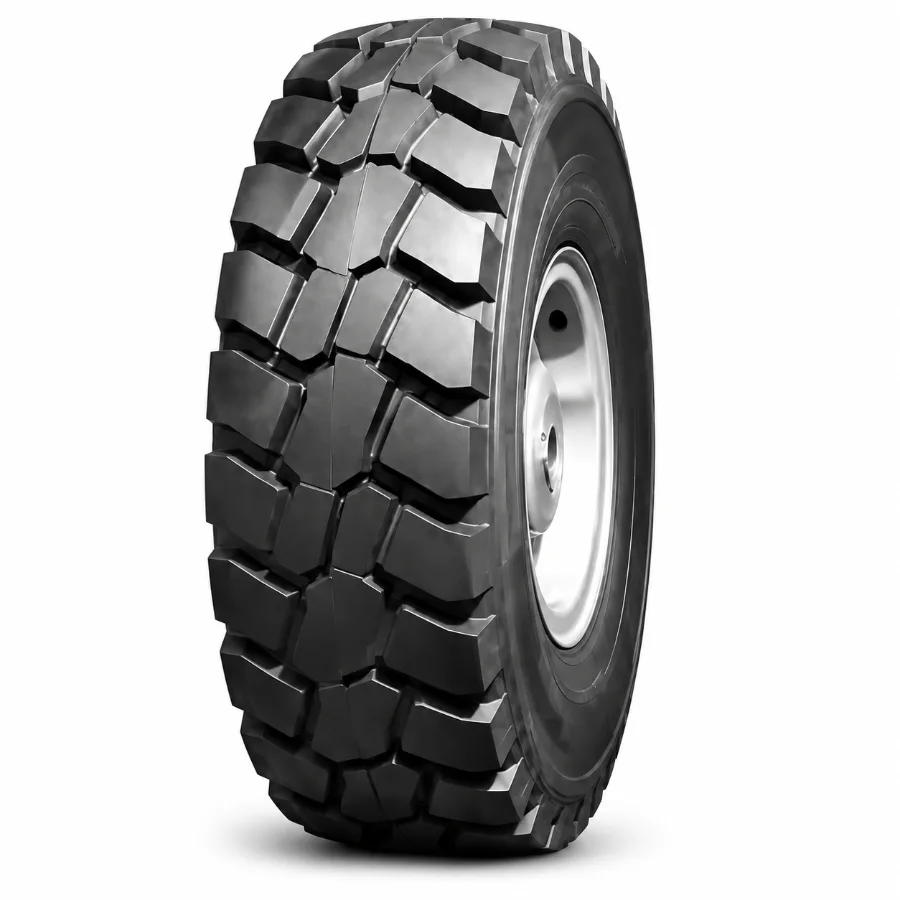
Series overview
This radial OTR tyre range is catalogued for port equipment and terminal handling cycles. The current range focuses on port applications. Selection starts with the listed size and pattern, then requires a check of the actual machine and operating cycle.
The IND-4/IND-5 designation identifies the port-oriented E-4 catalogue pattern. Compare it with the present tyre marking and equipment requirement. A matching code or size alone does not confirm fitment, load capacity or expected service life.
For this range, document paved terminal surfaces, turning frequency and concentrated operating loads. JABIL uses those inputs to confirm equipment type, wheel position, load, speed and shift pattern. Current tyre photos and a description of cuts, heat, wear or other failures help focus the review.
Priority range guidance
This radial port and industrial family contains three verified configurations. The 12.00R24 and 14.00R24 rows are three-star IND-5 TT/TL entries with 40 mm and 60 mm recorded tread depths. The 18.00R25 row is a three-star IND-4 TL configuration with a 13.00/2.5 rim and 63.5 mm recorded tread depth. The different codes and fitments should not be collapsed into one generic port tyre.
Selection starts with the exact straddle carrier, forklift or terminal machine, followed by wheel position, static and dynamic load, maximum travel speed, turning frequency and shift pattern. Container yards can combine concentrated loads, repeated braking and tight steering on hard surfaces, so route and operating rhythm matter alongside nominal size.
Typical review points include shoulder scrub, heat from repeated cycles, bead or rim issues and impact at joints or debris. Confirm the approved rim and pressure procedure, then compare the stated load index and speed condition for the selected row. Send current tyre photographs and removal records when asking for a cost-per-hour comparison.
Compare related E-2 ranges: bias E-4 port tyre
Technical data
TBC means the value is not present in the current source catalogue and must be verified before quotation. Load and pressure values are shown only at their stated speeds and must not be interchanged.
| Size | Star rating | Type | TRA code | Standard rim | Tread depth mm | Load index | Width mm | OD mm | Max load / pressure by speed |
|---|---|---|---|---|---|---|---|---|---|
| 12.00R24 | ★★★ | TT/TL | IND-5 | 8.50 | 40 | 180A5 | 315 | 1275 | 50 km/h: 7500 kg / 1000 kPa |
| 14.00R24 | ★★★ | TT/TL | IND-5 | 10.00W | 60 | 196A5 | 375 | 1415 | 50 km/h: 12500 kg / 1000 kPa |
| 18.00R25 | ★★★ | TL | IND-4 | 13.00/2.5 | 63.5 | 214A5 | 498 | 1673 | 50 km/h: 21200 kg / 1000 kPa |
Catalogue evidence
These statements use only the published product dataset; final machine fitment still requires technical confirmation.
IND-4/IND-5 is listed as a radial IND-4/IND-5 range with 3 sizes and 3 recorded configurations.
The catalogue associates this range with Straddle carrier, Forklift, Port equipment. Its current site filters place it under port-industrial conditions.
12.00R24: 3-star, rim 8.50, 1275 mm overall diameter, 315 mm section width. 18.00R25: 3-star, rim 13.00/2.5, 1673 mm overall diameter, 498 mm section width.
Buyer questions
The catalogue associates this tyre with Straddle carrier and Forklift and Port equipment. Final suitability depends on the machine model, tyre position, load, speed, rim and operating conditions.
The current catalogue lists 12.00R24, 14.00R24, 18.00R25. Use the technical table to compare PR, standard rim, dimensions, load, pressure and container quantity where verified.
IND-4/IND-5 identifies the port-oriented E-4 catalogue pattern. It is a starting point; it does not replace machine and duty-cycle verification.
Provide the tyre size, machine model, tyre position, load, maximum speed, daily hours, haul distance or cycle time, road condition, current failure mode, quantity and destination.
Continue with the radial vs bias OTR tyre duty-cycle guide →
Continue the comparison
Application check