
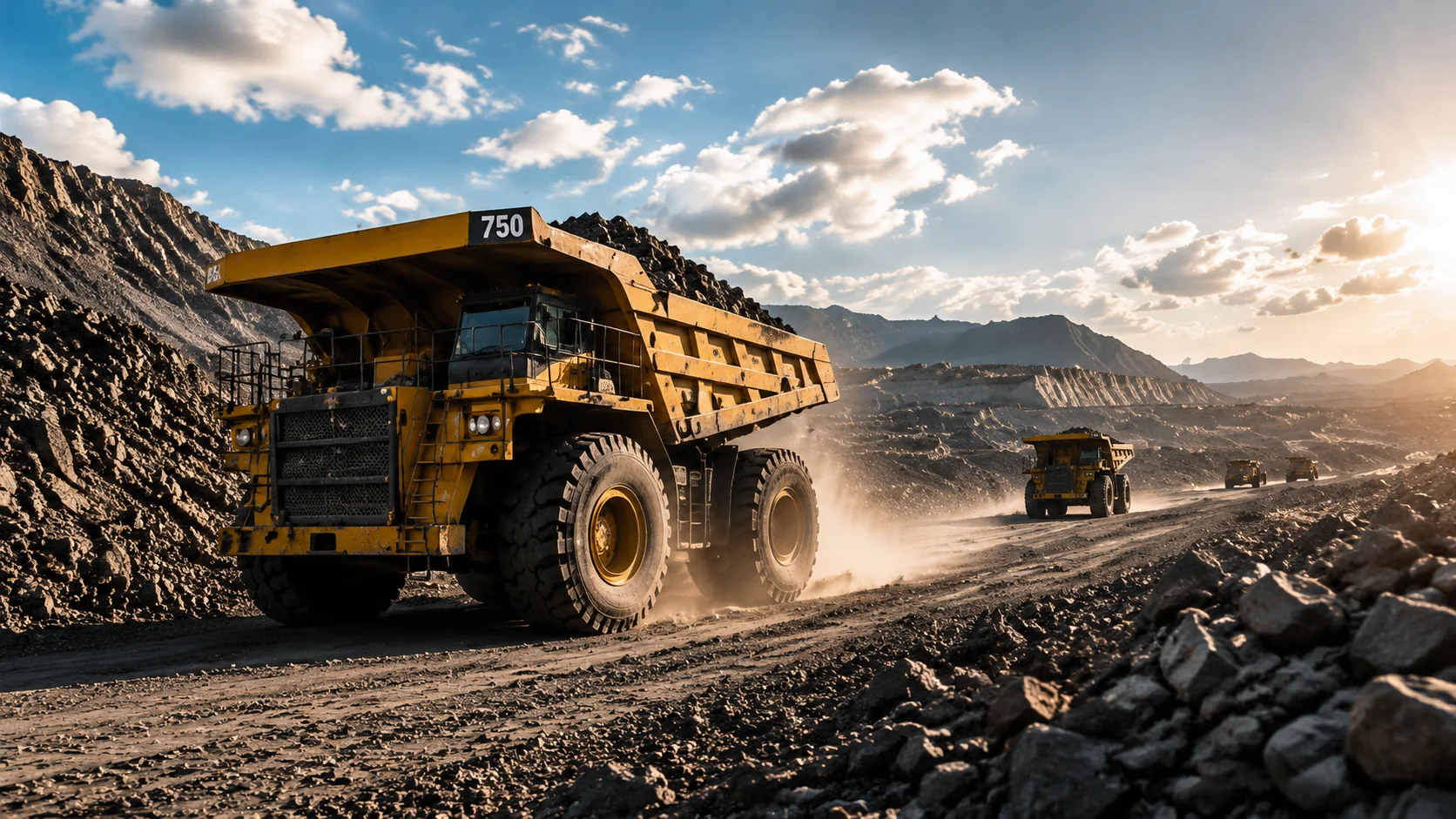
Komatsu announced on April 22, 2026 that it had commissioned its 1,000th autonomous ultra-class haul truck equipped with the FrontRunner Autonomous Haulage System. The milestone indicates that autonomous haulage has moved beyond isolated trials and into large-scale, continuous mine production.
For OTR tyre teams, the significance goes beyond the number of driverless trucks. More consistent speeds, routes and operating cycles can make tyre performance easier to measure. Continuous production also places greater importance on correct tyre selection, inflation control, heat management and haul-road maintenance.
The milestone at a glance
According to Komatsu, the 1,000th commissioned unit is a 930E-5AT electric-drive haul truck operating at Nevada Gold Mines in the United States. The truck has a stated payload capacity of 290 metric tons.
Komatsu says more than 500 of the autonomous trucks currently in service are from the 930E family. These figures describe Komatsu's fleet; they are not independent performance verification or a JABIL equipment-fitment claim.
Why autonomous haulage matters to tyre performance
Autonomous trucks do not remove the basic engineering limits of an OTR tyre. Load, speed, distance, gradient, road surface, ambient temperature and inflation pressure still determine how much heat and mechanical stress a tyre must manage.
What autonomy can change is operating consistency. A fleet-management system can regulate routes, speeds, spacing and cycle behaviour more consistently than a fleet with widely varying driving habits. This can reduce avoidable acceleration, braking and cornering variation, producing cleaner operating data for tyre analysis.
Four practical implications for mine tyre teams
1. Tyre selection still begins with duty-cycle data
A tyre should not be selected from size alone. Even where two trucks use the same nominal tyre size, requirements may differ because of payload, maximum loaded speed, one-way haul distance, road gradient, cycle frequency or underfoot conditions.
Data to prepare before quotation
- Equipment make, model, tyre position and rim specification
- Average and maximum payload
- Loaded and empty travel speeds
- One-way haul distance and cycle time
- Operating hours and shifts per day
- Maximum road gradient and surface condition
- Ambient temperature and moisture
- Inflation practice and main tyre removal reasons
2. Predictable cycles make heat management more visible
Large OTR tyres repeatedly flex under load, generating heat. If load, speed or travel distance exceeds the capability of the selected tyre, internal temperature can build faster than it dissipates. Repeatable autonomous cycles can make it easier to connect recurring heat issues with a gradient, loaded speed, queue pattern or section of haul road.
3. Haul-road condition remains a major variable
Automation can standardise how a truck is driven, but it cannot eliminate sharp rock, potholes, spillage, poor drainage or cornering forces created by road design. As utilisation grows, a fleet may repeat the same damaging path many times per shift. Road inspection therefore remains part of tyre management.
4. Better operating records support better purchasing decisions
Tyre evaluation should use comparable records rather than isolated impressions. Useful measures include operating hours, distance travelled, tonnes moved, removal reason, repair history and cost per operating hour. Stable routes and digital fleet records help teams compare performance by position, route and duty cycle.
What this means for OTR tyre suppliers
As mining becomes more connected, buyers will expect recommendations to be supported by application data. A useful supplier response should explain whether the proposed tyre matches the confirmed machine and rim, its intended application and limits, the available tread and compound options, and the monitoring required after installation.
This is especially important when a site changes from manual to autonomous haulage or introduces electric-drive equipment. A previous tyre choice should be reviewed if payload, speed, route, cycle frequency or equipment configuration changes.
JABIL's view
The 1,000-truck milestone reflects a broader shift in mining: equipment, fleet software and maintenance decisions are becoming more closely connected. OTR tyre selection needs to follow the same direction by using actual operating conditions rather than relying only on a familiar size or pattern.
JABIL's published catalogue covers specific bias OTR tyre sizes and applications. This article does not claim that JABIL supplies tyres for the Komatsu 930E-5AT. Buyers should confirm the exact machine model, tyre size, rim and duty-cycle data before requesting a recommendation.
Frequently asked questions
Autonomous haulage and OTR tyres
Do autonomous haul trucks require special OTR tyres?
Not automatically. The tyre must still be selected for the truck, rim, payload, speed, haul distance, road surface and ambient conditions. Autonomy may make the cycle more consistent, but it does not replace an application review.
Can autonomous haulage improve mining tyre life?
It can reduce some sources of operating variation. Komatsu reports an average improvement in tyre and brake life when its autonomous trucks operate within the design envelope. Results at an individual mine depend on the complete operating environment.
What information should a mine provide before requesting a quotation?
Provide the machine model, tyre size, rim, payload, speeds, haul distance, gradient, operating hours, road conditions, ambient temperature and current tyre problems. Photos of the machine, tyre markings and haul road are also useful.
Primary sources
- Komatsu: 1,000 autonomous haul trucks commissioned April 22, 2026
- Komatsu FrontRunner Autonomous Haulage System Accessed September 20, 2026
- Komatsu integrated technologies Accessed September 20, 2026